Why You're Exhausted but Can't Switch Off And What Your Body Is Trying to Tell You

You are so tired. And you’re really sick of feeling like it.
Not just a little tired. Bone-tired. The kind of exhaustion that sits behind your eyes and lives in your limbs. And you've been tired like this for so long that you've started to wonder if this is just… you.
Life.
So tired and yet when you lie down, sleep won't come.
Or you fall asleep easily enough but wake at 3am with your mind already racing.
Or you sleep a full eight hours and still wake up feeling like you've run a marathon. No amount of sleep cures it.
This isn't a problem with your sleep hygiene. This isn't you not trying hard enough. This is your nervous system stuck in survival mode. It has a story worth understanding.
You are tired but wired. And it won’t let you rest.
When the Body Forgets How to Rest
From the day we're born, the body is designed to move through stress and return to ease. The nervous system is built for this rhythm; action and rest, tension and release, DOing and BEing.
But for many people, life has asked too much for too long. Years of pushing through, of staying composed under pressure, of absorbing stress and never quite discharging it. When stress cannot be processed and released, the body stores it. It holds the stress in the spine and nervous system.
Over time, the nervous system stops cycling naturally back to rest. Instead, it gets stuck. It gets locked in a state of alertness that no longer has a real threat attached to it, but fires anyway, day after day.
In the Spinal Flow Technique, this pattern is understood as a blockage in the base gateway.
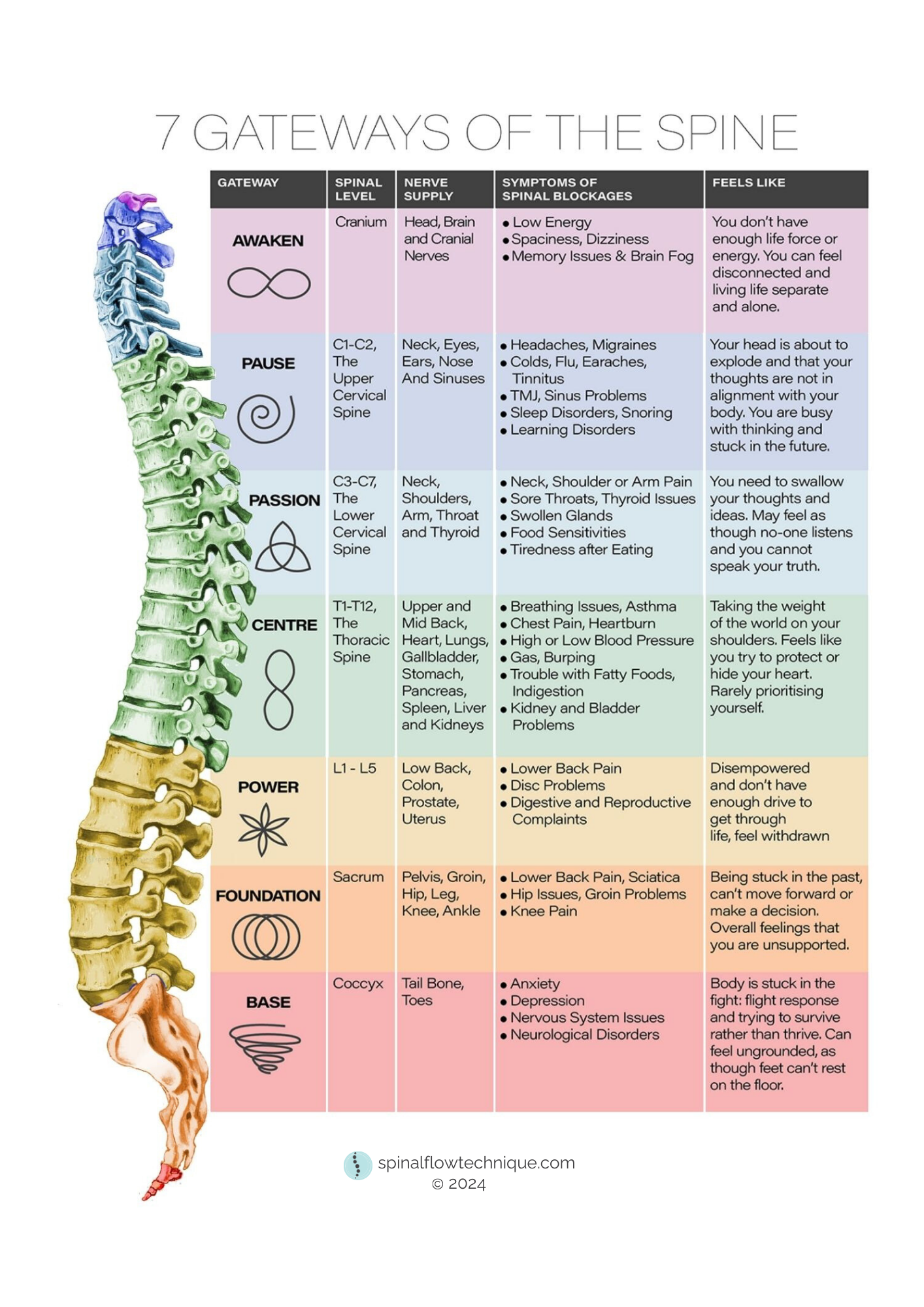
Spinal Flow 7 Gateways of the Spine
The Base Gateway — Your Survival Centre
The Base Gateway sits at the very foundation of the spine, at the coccyx and sacral area. It is the seat of the nervous system's survival response.
When the body experiences sustained stress, one of the first things to happen is that the tailbone subtly tucks under. It's the same response seen in a frightened animal pulling its tail between its legs. The body is signalling ‘I am not safe’.
When the Base Gateway is blocked, the dura mater, which is the protective membrane surrounding the spinal cord, becomes stretched and taut. The flow of life force energy through the spine is suppressed. The nervous system locks into fight/flight mode, running on nervous energy rather than genuine vitality.
The signs are unmistakable once you know what to look for:
Deep fatigue that doesn't improve with sleep
A persistent feeling of being "on" even when rest is wanted
Difficulty breathing deeply or fully
Feeling anxious or unsettled without a clear reason
Running on adrenaline and then crashing hard
Waking in the early hours with the mind already active
Does any of that sound familiar?
The Pause Gateway — When the Mind Won't Stop
There's often a second layer to this pattern and it lives at the very top of the spine, where the brain connects to the body. This is the Pause Gateway.
The Pause Gateway, which is C1 and C2, the first two cervical vertebrae, is right at the base of the skull.
When this Gateway is open and flowing, messages travel freely between mind and body. There's a sense of being grounded, present. Fully engaged and also able to truly switch off.
When it's blocked, the mind disconnects from the body. Thoughts race in loops. Life gets lived in the head often replaying conversations, projecting into the future, unable to drop into the stillness of the present moment.
Is the mind a busy place? Does lying down mean thinking rather than resting? These are not simply personality traits. They are signals that a nervous system has lost its connection between mind and body.
What This Looks Like in the Body
People carrying this pattern often share the same physical story. The tailbone is tucked. The head sits forward, as though the mind is always running ahead of the body. The breath is shallow and sits high in the chest rather than dropping into the belly.
The spine tells its own version of this story too; the quality of the tissue, the areas that brace and hold, the restricted movement at key gateways. The body has been compensating for a long time. It is doing its best. But it is exhausted from the effort.
What the Spinal Flow Technique offers is not a way to push through this, but a way to help the nervous system finally feel safe enough to let go of it.
What Becomes Possible With Flow
In Spinal Flow sessions, a certified practitioner uses precise, gentle touch at the spinal access points to communicate directly with the nervous system. Not forcing change but inviting it. The body responds not with effort, but with release.
As blockages in the Base and Pause Gateways begin to clear, something profound happens. The nervous system starts to remember how to cycle back to rest. The tailbone softens. The breath deepens. The mind begins to quieten, often for the first time in years.
Sleep improves. Energy becomes more sustainable. The background hum of alertness starts to settle.
"I'd forgotten what it felt like to wake up and not already be tired. Within a few weeks of starting Spinal Flow, I was sleeping through the night for the first time in years."
Rest Is Not a Reward — It's a Biological Necessity
The body isn't broken when it can't switch off. It's stuck. It’s running a programme that was once necessary for survival but most likely no longer serves current life needs.
Rest is when the nervous system repairs. It's when the immune system does its best work, when the body integrates, heals and restores. Without genuine, deep, parasympathetic rest every aspect of life begins to suffer.
If exhaustion has become the norm, the body is asking for something it hasn't been given; Safety. Space. Permission to finally, fully exhale.
Spinal Flow is one of the most powerful ways to give the nervous system exactly that.
Reach out to book a session and take the first step toward real, restorative rest.