The sun is your friend
Sunlight & Suncreams — The Balance Between Protection and Nourishment
Theme: Reframing sun protection through a wellbeing lens.
Summer is coming!
Here in the Southern Hemisphere Summer is coming. And oh the joy of it!
That said I await the incoming bombardment of advertisements imploring every man, woman and child to be afraid.
Be very very afraid.
Of what you say?
The sun
Our sun
Agh
Well, my lovely, I’m here to share with you that the sun is your friend! You need not be afraid.
As it turns out, we are all solar powered!
With the incoming tsunami of desperate suggestions to ‘stay out of the sun’ and ‘lather up’ I am compelled to take you on a journey back to embracing this realm’s most powerful source of life, light, energy and health.
It’s a history, biology and science-based journey of information and good-health options to counter the narrative that we all should be afraid of our beautiful orb.
First the narrative.
“The sun is damaging and dangerous and causes ill-health”
“Sunscreen is your life saver, blocking out the sun and protecting you from said ill-health”
When all is not what we’re told
I’d like to suggest that this follows the same profit-over-health patter we have now had pushed into society for decades. I remember as a child the Australian advertisements with ‘Norm’ beginning the ‘slip, slop, slap’ mantra. Slip on a t.shirt, slop on sunscreen and slap on a hat.
Seems innocuous, even health-promoting. Turns out it’s what’s hidden in the middle that’s not.
So, in certain situations this is sound advice, with a caveat that I will get to.
Please note, and before I go any further, I am in no way condoning spending all day in the blazing sun that leaves your beautiful skin. No, that’s plain foolish. Please, don’t do that.
What I am suggesting is that regularly getting a moderate amount of sunlight onto your bare - and wisely protected - skin is health-promoting.
What must change – for our health’s sake - is the dispensing of toxic sunscreens and the engagement of common sense and an understanding of natural options as protections from burning badly. They do exist.
What’s in that bottle?

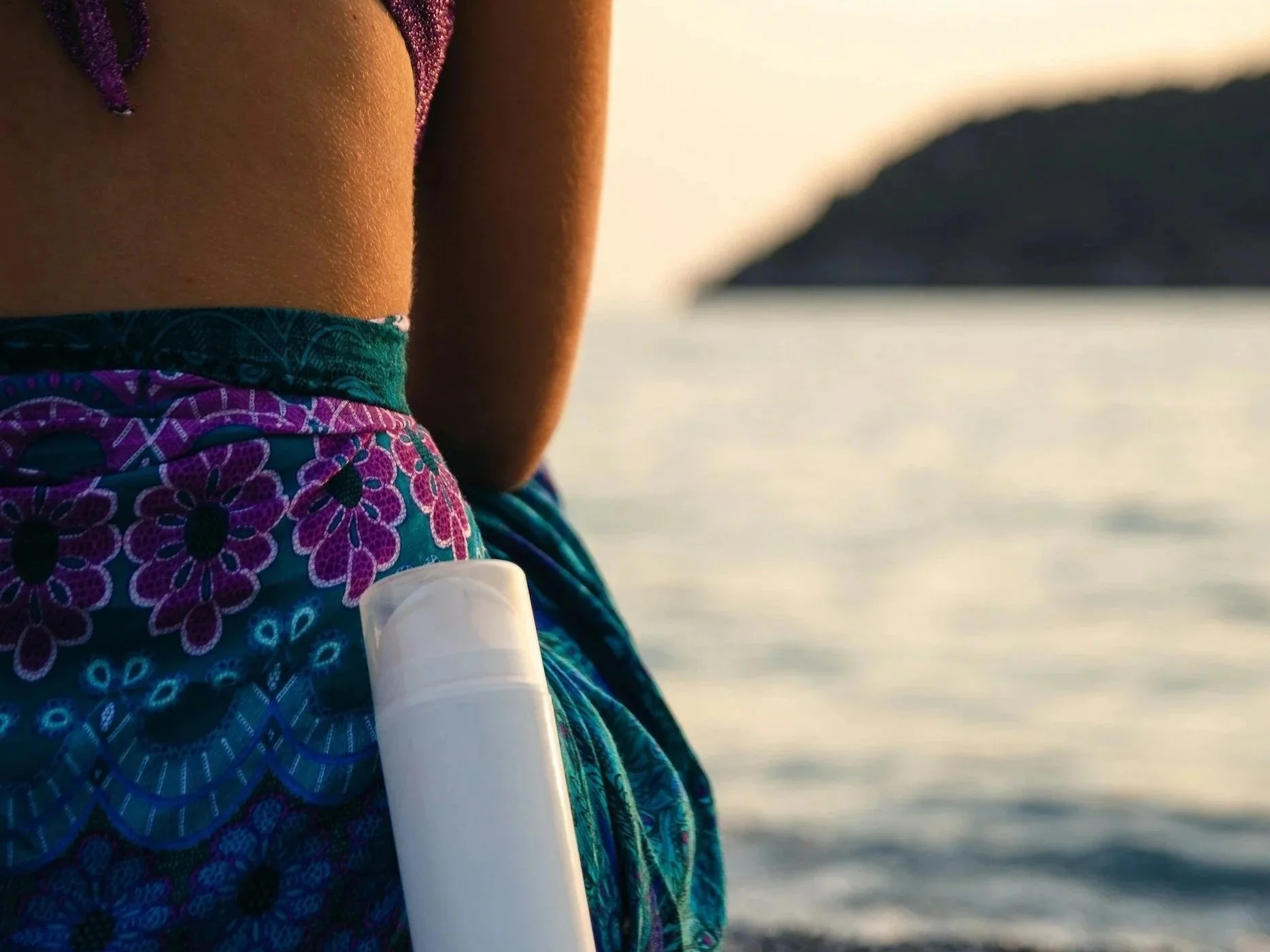
Baby at beach with sunscreen on nose
Next time you reach for that lotion you lather on (you and your children) to ‘safely’ go into the sun, read the ingredients listed on the bottle.
On average I’ll bet they include chemicals like avobenzone, oxybenzone, octinoxate, octisalate, octocrylene, and homosalate. And more.
I checked several of the most promoted Australian brands and here is the list from probably the #1:
“Active Ingredients: Octocrylene 8% w/w, Homosalate 6% w/w, Butyl Methoxydibenzoylmethane 3% w/w
Contains: Phenoxyethanol”
Given that everything we put ‘on’ our skin ends up in our blood stream these are worth looking into, wouldn’t you say? Especially as they are often literally baked into the skin, making their absorption a sure thing.
So, looking at the Environmental Working Group website – a group working FOR your health and wellbeing - on the dangers of sunscreen they say, and I’m quoting:
Evidence of the endocrine-disrupting effects of two of the ingredients, oxybenzone and octinoxate, is mounting. Studies have also highlighted concerns about endocrine-disrupting effects of other ingredients, such as homosalate, avobenzone, octisalate and octocrylene, although evidence is more limited.
In 2021 the European Commission Scientific Committee on Consumer Safety, or SCCS, published final opinions on the safety of three non-mineral ultraviolet, or UV, filters, oxybenzone, homosalate and octocrylene. It concluded that homosalate and oxybenzone aren’t safe in the amounts they’re used. This led the European Union to lower the amount of these filters allowed in certain sunscreens.
The ingredients oxybenzone, octinoxate, octisalate, octocrylene, homosalate and avobenzone are all systemically absorbed into the body after typical sunscreen use, according to studies published by the FDA. These studies also reported that the ingredients could be detected on the skin and in the blood weeks after they were last used.
Other studies have reported detecting sunscreen ingredients in breast milk, urine and blood plasma samples, confirming they’re absorbed into the body through skin.”
I can’t help but wonder what the real impact of baking these chemicals into our system truly is.
As a race, what price for blind faith and convenience have we paid?
As a health-promoter, evidence presented by bodies who do not profit from the information they share is to be weighted heavily in my considerations. This and so much more information is why I do not advocate the use of commercially produced pharmaceutical-based sunscreen. Ever.
It’s not just the endocrine system that they impact but let’s start there.
What is so important about the endocrine system?
And why should we want it unimpeded? (so no ‘endocrine disruptors’ in our wellbeing routines?)
In a nut shell, the endocrine system creates and distributes our hormones. There are no less than 50 that are responsible for our growth and development, metabolism, sexual function and reproduction, our mood, sleep and our general state of health – blood pressure, core temperature, electrolyte levels and balance and more. So, important. Wouldn’t you say? And it seems prudent to assert that it’s better if these functions are not impaired – disrupted – in any way.
This beautiful body of ours is always working to keep us healthy, upright and functioning. What we put in, and on, our body impacts that ability. ‘Endocrine disrupting’ is not in any way going to help it.

Beautiful lady enjoying the sun
Benefits of the sun
I could write a whole blog on just that. So I will – that is part 3 in this series.
So much is made of ‘vitamin D’ and how important it is for health.
‘Vitamin D’ is synthesised in our body (kidneys) in response to exposure to the sun. Technically speaking it’s a hormone. A master hormone.
It is distributed within our being by the endocrine system.
This biological mediator is the hormone behind our very existence.
It is sunshine – in the eyes – that triggers our body to start to increase our D levels.
‘Vitamin D’ levels play a significant part in the synthesis and modulation of our sex hormones.
Sunlight helps to regulate our circadian (wake/sleep) rhythm (regular deep sleep can help with weight management), elevates serotonin (our happy hormone) so is a defence against anxiety and depression, is thus a remedy for ‘SAD’ or ‘seasonal affective disorder’ – AKA ‘not enough sun/vitamin D’ - fortifies bone strength (without adequate levels of D the body can’t effectively absorb calcium), improves heart health, lowers blood pressure, helps with detox pathways (sweating is good), boosts natural immunity and thus helps our body prevent and overcome all manner of conditions and diseases (including a list of cancers) and SO MUCH MORE.
Do you know that there was a time when returning soldiers who suffered from ‘shell shock’ (now labelled ‘ptsd’) were treated with ‘sunshine therapy’? With the modern focus on pharmaceuticals as a cure-all, this is long ‘forgotten’.
Sunshine is life-giving, enhancing and prolonging.
Options for natural skin protection?
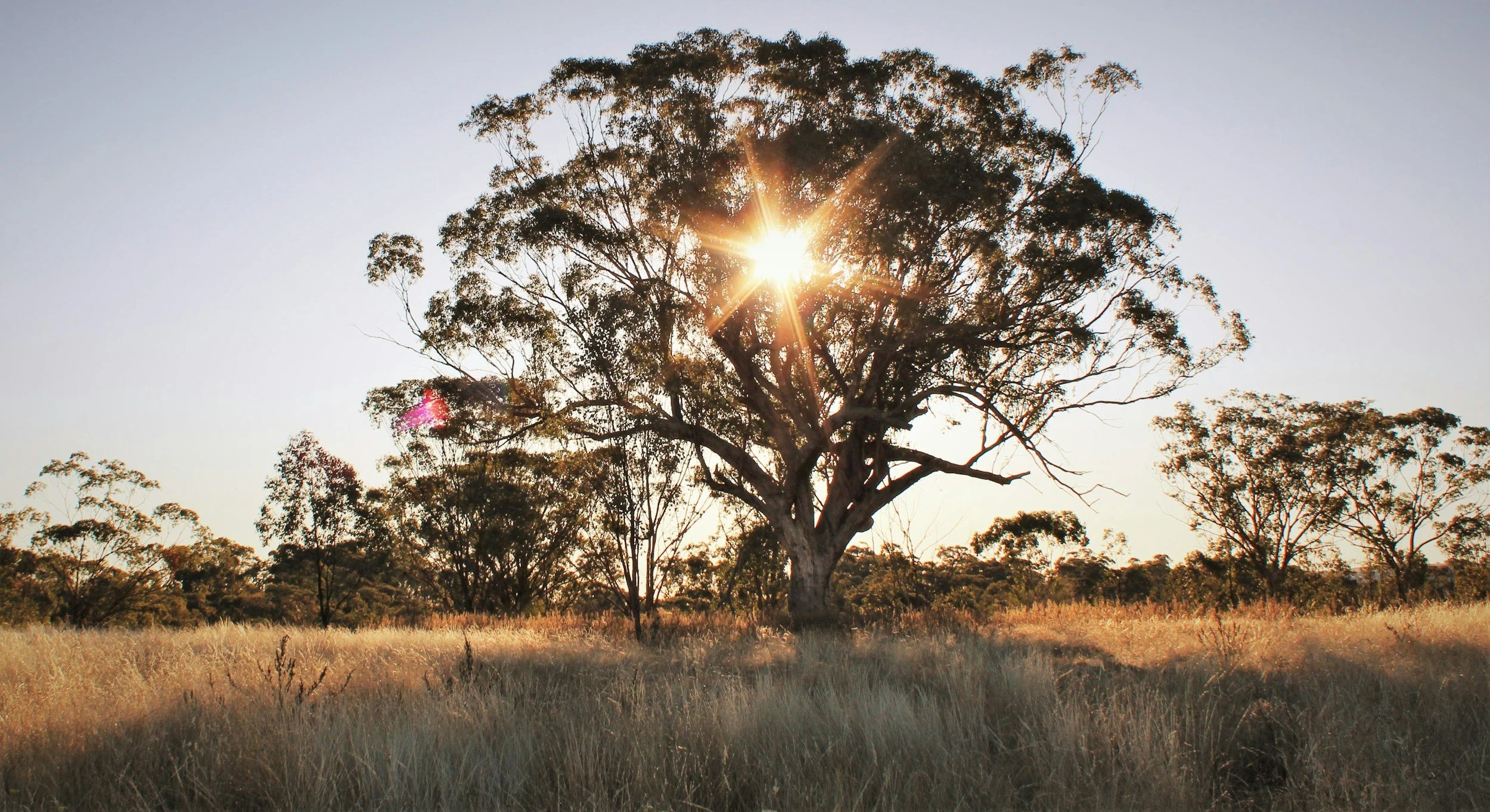
Sun shining through Australian gum tree
So what to do when the sun is blazing and we’d like not to burn?
The obvious option is to stay in the shade. But if there is no choice but to be outdoors in the hotter part of the day, then it’s time to ‘cover up’ but with lighter clothing (wear a light cotton shirt with long sleeves), a wide brimmed hat that especially protects the back of your neck and stay hydrated.
Remembering that the sunshine is health-promoting, let’s find sensible ways to get a little exposure whilst protecting our skin from burning. It’s a personal thing – so be responsible with yourself and if/when you feel your skin ‘burning’ find some protection or move out of the direct sunlight. Aim not to be unprotected in the hottest part of the day (for too long at least). Remember only mad dogs and English men stay in the midday sun !?!? I love the English (my 2nd home). So don’t be a mad dog!
You may not realise it, but we can build our skin’s own defences to burning and thus the impact of the sun. Consuming a nutrient-dense diet high in healthy fats and antioxidants can fortify the skin. These include avocados, leafy greens, nuts and seeds, fruits and especially berries.
A well-hydrated skin also tends not to burn so quickly so sipping on water loaded with natural electrolytes (think, lemon, cucumber and sea salt) will help keep defences higher. Eating your hydration is a great way to keep levels hydration levels in a healthy range – eg. watermelon, infact all melons, berries, oranges, apples, mangoes, cucumbers, celery and tomatoes – not only bring you the purest forms of ‘water’ and electrolytes they also promote a healthy skin and work to build those natural defences.
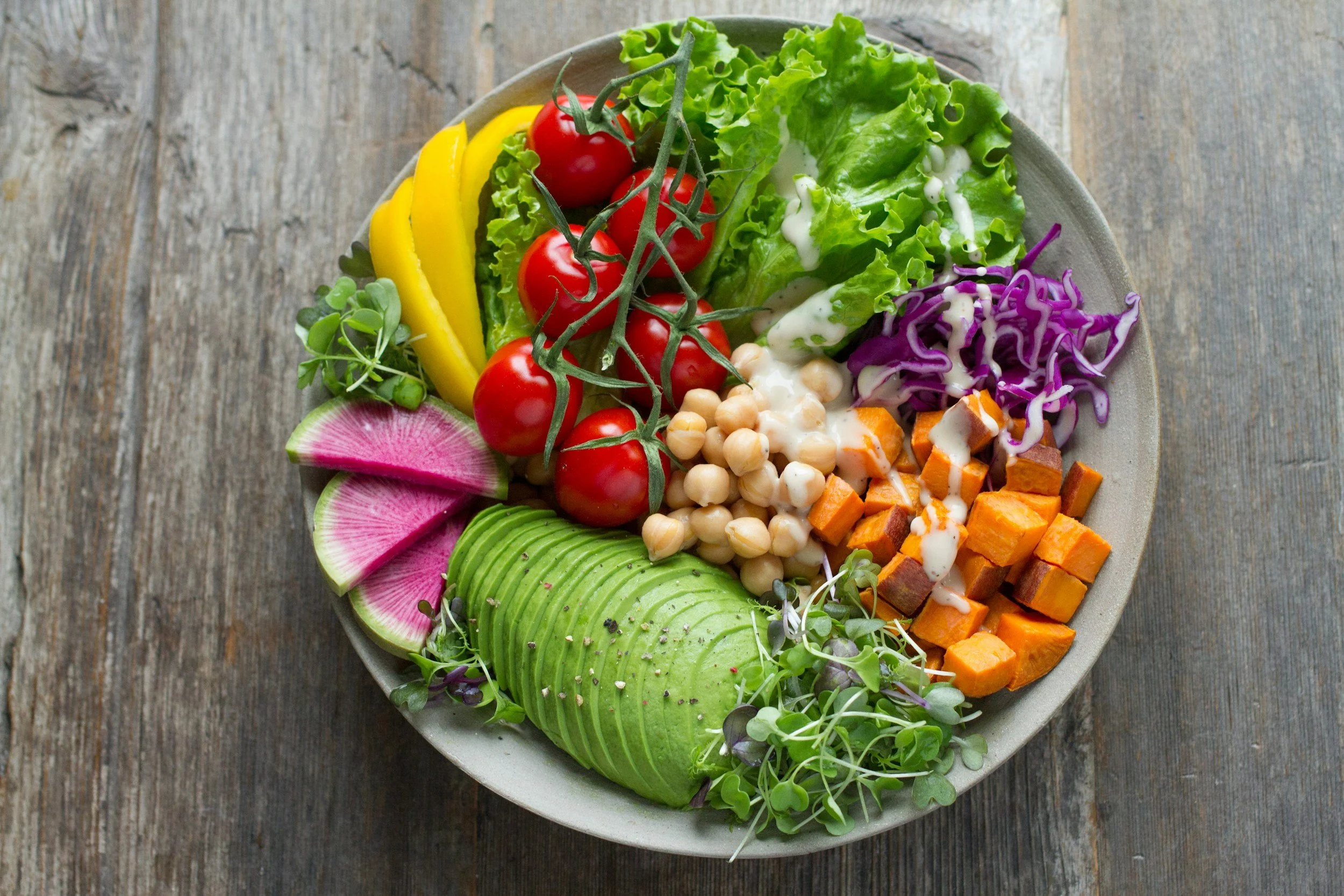
Plate of healthy food
In terms of what to use on your skin there are naturally occurring oils that offer some UV protection (I’m covering ‘UV’ in my next edition). Believe it or not coconut oil offers protection and when combined with red raspberry seed oil and/or carrot seed oil the protection is amplified – carrot seed oil has an estimated SPF of 38-40. A very basic message - whatever you choose to put on your skin, be sure that it doesn’t contain toxic chemicals.
Keeping skin hydrated is important not just for when summer is near. Using oils on our skin all year-round makes for a beautiful tone and health to our outer layer! So find your favourite all-natural moisturising cream (or make it yourself) and use it each time you bathe. This way your skin will be healthy, soft and supple all year round and better equipped to tan but not burn in summer.
Our wellbeing is dependent upon our sun and our exposure to it. We need not fear it. Along with a healthy nutrition plan and a sensible approach to protecting ourselves from ‘baking’ in the sun, I propose that sunshine – and the naturally occurring tan that results from expose to it – is health-promoting.
There is no coincidence that we generally feel better, more active and more ‘alive’ in summer. What do you think?
‘Sunlight and sunscreens: The balance between protection and nourishment’
The most important thing? Please, do your own research before buying and using anything on your skin that is literally baked into the blood stream. And eat for year-round health and vitality.
Come back for part 2: ‘Sunlight, Red & Blue Light Therapy — Short and Long Waves for Healing’ to know more about how to effectively use light in all its forms to promote and optimise your wellbeing.
If you have any questions or thoughts you’d like to share please contact me directly. It would be great to hear from you.
Bye for now
Simone